European MPs call for probe into FIFA boss Infantino over red card suspension

Controversy over red card decision
European lawmakers have initiated a call for an investigation into FIFA President Gianni Infantino following a decision to overturn the World Cup suspension of US striker Folarin Balogun. This move has raised questions regarding potential influence from US President Donald Trump.
A group of members of the European Parliament launched an initiative to probe Infantino’s role in the decision. A letter circulated within the European Parliament urged football associations across the European Union to seek a formal FIFA review of the decision-making process and any possible political interference.
Balogun, who is the US‘s leading goalscorer in the tournament, received a red card during the US‘s victory against Bosnia and Herzegovina on July 1. Typically, this would result in a suspension for the subsequent match. However, FIFA lifted his suspension for a match against Belgium on Monday, after President Trump reportedly contacted Infantino.
FIFA stated that its disciplinary committee made the decision. This marks the first instance in modern World Cup history where a red card issued during the tournament did not lead to a suspension.
UEFA, Europe‘s football governing body, described the decision as “unprecedented, incomprehensible and unjustifiable.”
Political interference allegations
President Trump acknowledged his request to FIFA to re-examine Balogun‘s case, describing the red card as “horrible.” He maintained that he did not demand a specific outcome and could not dictate actions to Infantino.
He added that the suspension “would have left a big stain” and that both the US and Belgium should have their top players available for their match. The US subsequently lost to Belgium 4-1 and was eliminated from the World Cup.
European Parliament lawmakers Barry Andrews, Lara Wolters, and Niels Fuglsang issued a joint statement, asserting that FIFA‘s decision to “change the rule on red card suspensions mid-tournament is a disgrace and a perversion of justice.” They further commented that Infantino and FIFA had once again yielded to the demands of the Trump administration, with 35 colleagues joining their petition.
The lawmakers emphasised that the integrity of sport relies on impartial and transparent rules, and that fairness is compromised when political pressure influences who plays.
Infantino defended his conversation with President Trump, stating that he informed the US President that FIFA‘s independent judicial bodies handled the matter. He affirmed that this is how FIFA‘s system operates, a principle he intends to uphold.
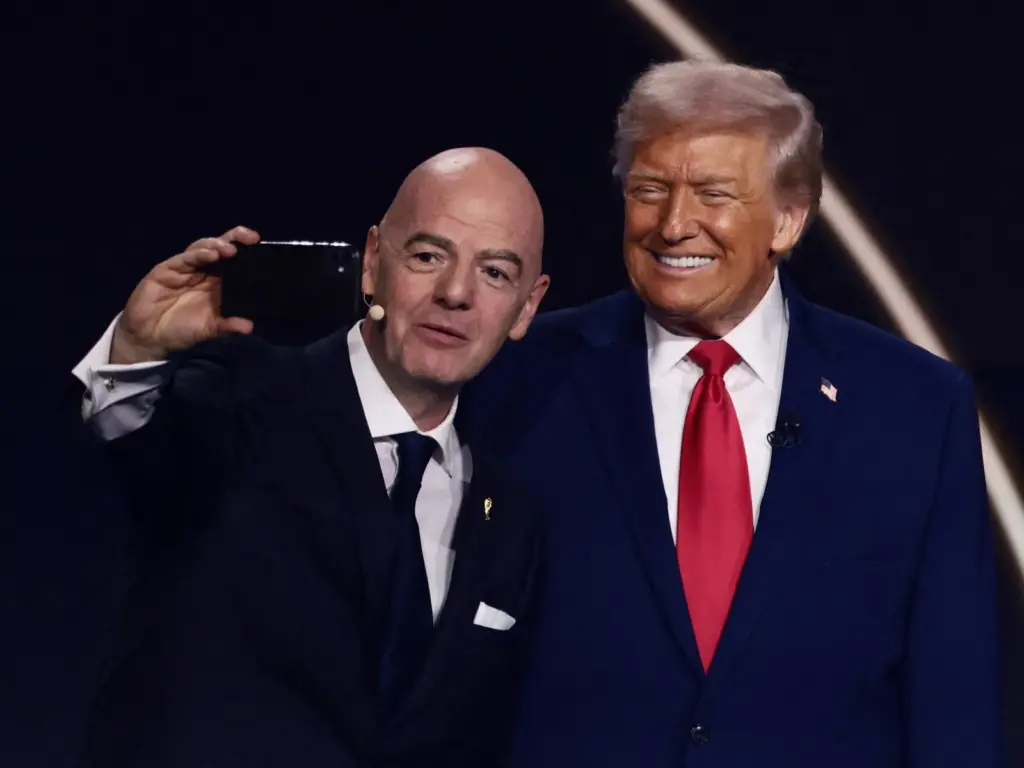
Infantino has developed close ties with President Trump, having presented him with a newly created “FIFA Peace Prize” last year.
Broader implications and reactions
UEFA reiterated its strong criticism of FIFA‘s decision not to uphold Folarin Balogun‘s automatic ban, calling it “unprecedented, incomprehensible and unjustifiable.” The organisation stated that intervening to effectively cancel a tournament suspension “crossed a red line.”
Of the 188 other red cards issued at the World Cup, only one other player, Brazil‘s Garrincha in 1962, escaped a suspension, which occurred before automatic bans were standard and was reportedly influenced by political factors.
President Trump thanked FIFA for “reversing a great injustice” on Sunday. The Royal Belgian Football Association (RBFA) stated on Monday that it had “no alternative but to challenge the player’s eligibility for the upcoming match.”
Belgium‘s foreign minister, Maxime Prevot, suggested that if a phone call was the reason for the decision, it would be a “blatant violation of the most basic rules of football and sport.”
Former FIFA president Sepp Blatter commented that “football must never become a playground for political power.” UEFA asserted that an automatic one-match suspension “is not a discretionary option” and is “a principle embedded in regulations.”
UEFA expressed concern that when the certainty of rules is not guaranteed by its guardians, the integrity of the game and the credibility of a competition are undermined. They also noted that such a decision sets a precedent, requiring similar situations to receive equal treatment, potentially to the detriment of the competition.
Glenn Micallef, the European Union‘s commissioner for sport, stated that decisions in sport “belong to sporting bodies, not politicians,” and that influencing such decisions would undermine the autonomy of sport.
England coach Thomas Tuchel expressed confusion regarding the disciplinary process at the World Cup following the Balogun decision. He questioned the consistency of decisions, particularly after Jarell Quansah was sent off in England‘s 3-2 victory over Mexico.
Tuchel highlighted that both Balogun and Quansah were sent off after VAR reviews, leading to uncertainty over the rules. He questioned who overturns such decisions and on what grounds, expressing a desire for consistency.
Belgium head coach Rudi Garcia remarked on Sunday that he did not realise July 5 at the FIFA World Cup had become April Fool’s Day, stating that the concern was for football itself.
The RBFA reported that FIFA “refused to respond to the RBFA’s legitimate requests” for information, including a copy of the decision, an explanation of the process, and applicable regulations. FIFA responded by considering the request an appeal, appointing a judge, and providing only a few hours’ notice.
The RBFA noted that for an appeal to be admissible, written reasons must be communicated first, which they had not received. The association expressed deep concern and vowed to continue fighting for ethics, fair competition, and the interests of football.
If FIFA upholds its decision, the Court of Arbitration for Sport (CAS) has established an ad hoc division to hear appeals. Blatter reiterated that red cards are overturned by rules, evidence, and independent bodies, not political phone calls, and questioned FIFA‘s direction if a US President intervenes in such matters.
Balogun was sent off after his foot landed on the ankle of Bosnia‘s Tarik Muharemovic. FIFA invoked a clause in its disciplinary code allowing it to “fully or partially suspend the implementation of a disciplinary measure,” despite tournament regulations stating that a red card automatically suspends a player from their subsequent match.
Reports suggest the US questioned the use of slow-motion replays in the VAR review, although VAR protocol was reportedly followed correctly.
Read Also
Source: timesofindia.indiatimes.com

